
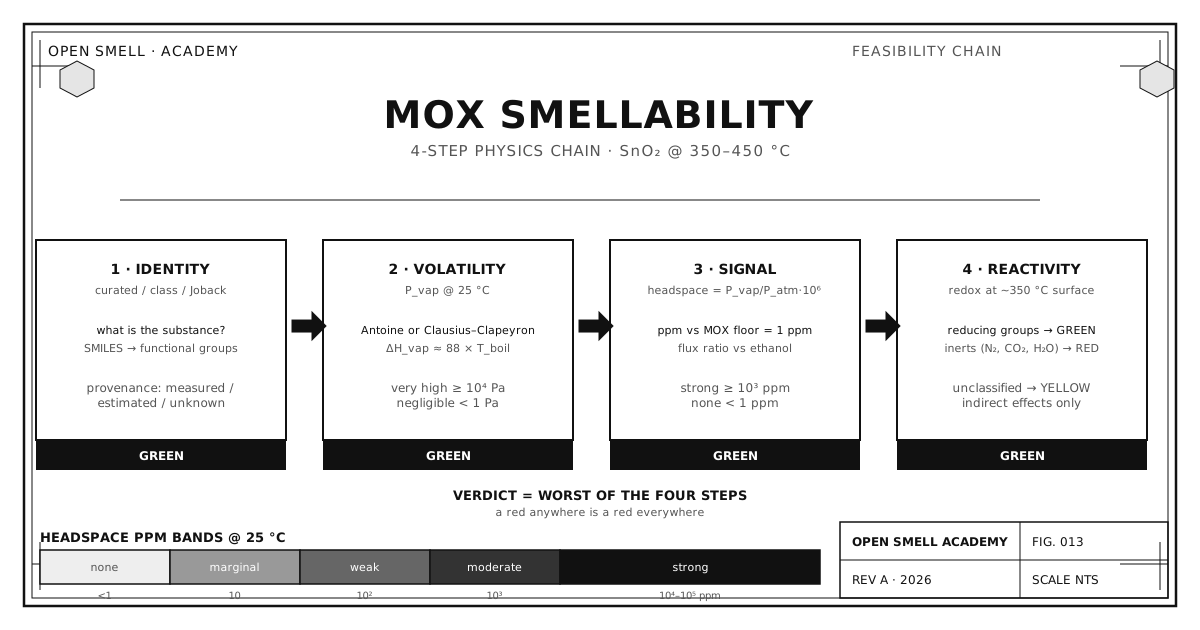
Before you buy sensors, choose a sensor count, or record a single exposure, there is a boring question you should answer first: will the target molecule actually produce a detectable response on a MOX array?
That question is not answered by your nose. The human nose and a metal-oxide semiconductor (MOX) sensor are different instruments with different response functions, and confusing the two is the most common source of failed e-nose projects. This essay is about the physics of the question — the four-step chain that turns "will it smell?" into a falsifiable verdict. It is the theory behind the smellability engine in the OpenSmell SDK and the browser toolkit.
Your Nose Is Not a MOX Sensor
Humans detect thiols and mercaptans down at parts-per-trillion to parts-per-billion concentrations. That is why a few drops of ethyl mercaptan can make a gas leak obvious to every nose on a street. Commodity MOX sensors do not work that way: their datasheets specify response ranges in the parts-per-million decade (an MQ-3, for instance, is rated for roughly 25–5,000 ppm of ethanol-family gases). A compound can therefore be:
- Strongly smelly to humans, nearly invisible to a MOX — a volatile thiol at trace concentration;
- Dull to humans, obvious to a MOX — ethanol in hand sanitizer smells faint but saturates a headspace with tens of thousands of ppm;
- Smelly to everyone, dead on a MOX — pure nitrogen has no smell, but neither does it reduce the sensor surface, so a flow of nitrogen is not a signal.
The nose detects specific receptors firing; a MOX detects reduction of a hot metal-oxide surface. That single mechanistic difference drives everything below.
What a MOX Sensor Actually Measures
A MOX sensor is a sintered film of tin dioxide (SnO₂) held at roughly 350–450 °C. At that temperature, oxygen chemisorbs onto the surface, trapping electrons and raising the film's resistance. When a gas arrives that can be oxidised by the surface oxygen — a reducing gas — the surface releases those electrons and the resistance drops. The resistance change is the signal.
So feasibility decomposes into exactly two physical requirements:
- Volatility — enough of the molecule must reach the sensor surface in the gas phase.
- Reactivity — the molecule must be redox-active at the operating temperature.
Both must hold. A perfectly reactive molecule that never leaves the liquid phase is invisible. A volatile molecule that cannot reduce the surface produces only background changes. The smellability engine grades both, and the answer is only as good as the worst of the two.
The Four-Step Chain
The engine runs the following chain for every substance under test. Each step emits a verdict in green / yellow / red; the overall verdict is the worst step. A red anywhere is a red everywhere.
Step 1 — Identity
First the engine must know what it is looking at. A lookup can resolve a name to:
- a curated entry (measured boiling point, curated functional groups) — the most trustworthy path;
- a composite entry (a known mixture with recorded constituents and weight fractions);
- a chemical class term (e.g. "terpene", "thiol") with class-level properties;
- or, when you hand it a SMILES string, a de novo estimate via group-contribution (Joback) theory — a boiling point and functional groups inferred from the structure.
Every property in the chain carries a provenance: measured, estimated, or unknown. That provenance is what sets the verdict's confidence — estimated properties never pretend to be measurements.
Step 2 — Volatility
The engine estimates vapor pressure at 25 °C. For curated substances it uses Antoine coefficients (NIST data); otherwise it falls back to the Clausius–Clapeyron equation with Trouton's rule for the heat of vaporization:
ΔH_vap ≈ 88 × T_boil          (J/mol, Trouton)
P_vap(298 K) via Clausius–Clapeyron
Pure gases are assigned full atmospheric pressure (they are the vapor phase). The result is graded against volatility bands: ≥10,000 Pa "very high", 1,000–10,000 "high", 100–1,000 "moderate", 1–100 "low", below 1 Pa "negligible".
Step 3 — Signal
Next: how strong would the sensor signal actually be? The engine computes the saturated headspace concentration an ideal enclosed chamber would present:
ppm_headspace = (P_vap / P_atm) × 10^6
and a flux ratio of the compound's diffusion-weighted flux to that of ethanol (the reference substance), using the Fuller–Schettler–Giddings method where diffusivity scales roughly with molecular weight.
The headspace is graded against the sensor's detection floor — 1 ppm — in bands: ≥1,000 ppm "strong", 100–1,000 "moderate", 10–100 "weak", 1–10 "marginal", below 1 ppm "none". Note how strict this is: the engine's floor is 1 ppm while an MQ-3's rated range starts at 25 ppm. A "marginal" verdict is already optimistic for most cheap arrays.
Step 4 — Reactivity
Finally, the chemistry: are the molecule's functional groups redox-active at MOX operating temperature? The engine maps groups (alcohols, aldehydes, ketones, esters, acids, terpenes, thiols, sulfides, amines, phenols, aromatics, ethers) as reducing / oxidisable → green. True inerts — N₂, O₂, CO₂, noble gases, water — are red: they cannot undergo the surface reduction the sensor detects. Anything unclassified is yellow: any response would be indirect (humidity baseline shifts, oxygen partial-pressure changes, matrix effects), not a true analyte signal.
Aggregation
The verdict is the worst of the four steps. For composites, each constituent runs the full chain and the constituents' signal scores are combined by weight: red if red weight dominates, yellow if the non-green fraction is substantial. Confidence falls to low/medium whenever properties were estimated rather than measured. Two extra blocks round out the answer:
- crossCheck — a capacity check: can an N-sensor array resolve this substance within your existing labeled library? It reports label overlap. It does not promise mixture decomposition, and it explicitly flags that cross-sensitivity to your library is unknown until you add labeled sessions.
- guidance — capture advice tuned to the expected signal: short exposures for strong/fast responses, maximised headspace and long windows for weak/slow ones, always clean-air baseline → exposure → recovery.
"It's a Complex Material" — the Constituent Fallback
Most real targets are not a single curated molecule. A ripe banana is dozens of compounds; a diesel exhaust is hundreds. The chain has a principled answer rather than a shrug: decompose, grade, and combine.
If you know the material's constituents — as SMILES strings or formulas and rough weight fractions — the engine runs the full four-step chain per constituent and produces a weighted composite verdict. A banana's profile, for example, is dominated by isoamyl acetate (an ester — green reactivity, moderate volatility), backed by ethyl butyrate and 2-methyl-1-butanol; each contributes a verdict proportional to its share of the headspace.
The engine does not hallucinate a compound it cannot identify. If you supply O=C=O it tells you it is carbon dioxide — an inert oxide with no reducing chemistry — and grades it red for MOX reactivity, regardless of how strongly you might associate "CO₂" with a smell. The verdict always traces back to the chemistry you actually handed it.
Making It Falsifiable
Every verdict should be a prediction you can go and break. That is the discipline the whole stack tries to hold itself to, and the smellability engine is no exception.
Concrete example — ethanol. The chain predicts: saturated headspace at 25 °C ≈ 78,000 ppm (well into "strong"), flux ratio 1.0 (it is the reference), reactivity green (an alcohol oxidises at ~350 °C), response fast. Overall: green.
How you would falsify that: put a few ml of ethanol in a sealed jar at room temperature, let it equilibrate, run the capture protocol, and check. If no channel moves above the noise floor while a "moderate" compound does, the volatility estimate is wrong for your rig. If nitrogen produces a response equal to ethanol, the reactivity classification is broken — or your flow control and oxygen baseline are.
Troubleshooting, in order:
- No response on a predicted "strong" substance — is the container sealed? Did you let the baseline settle to a stable resistance before exposure? Is the sensor actually at operating temperature? (A cold sensor is a resistor, not a detector.)
- Response only during the recovery phase — you are probably measuring a humidity swing from your breath or the room, not the analyte.
- Everything triggers everything — your flow rate or oxygen baseline is uncontrolled; MOX responses are strongly modulated by oxygen partial pressure, which is exactly why pure O₂ or N₂ must not be graded green.
- Cross-sensitivity surprises — a compound you did not expect is dominating. Add its label to the library and re-run the crossCheck.
Two claims the engine deliberately does not make, because it lacks the per-rig reference data to back them up: calibrated parts-per-million measurements (calibration on real cross-device data measured a fall from 47% to 33% accuracy — see the evaluating-models essay) and the ability to separate isomers like limonene from pinene on a small array. The honest next step is a rig-reference layer: record known concentrations on your hardware and let the chain's predictions be tested against them. The chain ships the prediction; you supply the reference.
Actionable Guidance
The single highest-leverage lever for weak signals is temperature. Vapor pressure grows roughly exponentially with temperature (Clausius–Clapeyron again), roughly doubling every 10–15 °C. A compound that is "negligible" at 25 °C can jump two or three decades by warming the sample to 60 °C — within a sealed bag or glass jar, never an open flame. The engine's guidance block will tell you when to do exactly this: it maximises headspace and lengthens capture windows for anything below "moderate", and it keeps exposures short for the strong/fast cases so you do not saturate the array.
Beyond that, the rules are short:
- Maximise headspace — a sealed bag or jar, not an open dish; sniff the headspace, not the liquid.
- Keep the distance short — a few centimeters, not a meter; concentration falls with distance.
- Control the baseline — clean air, stable resistance, then expose, then let it recover fully.
- Match the sensor family to the target — different MOX parts are tuned to different gas classes; a carbon-monoxide detector is not an ethanol monitor.
- Do not over-promise the array — four real MOX sensors have effective dimensionality around 2–3; grade a single substance, resolve against your library, and stop there.
Sensor Poisoning: The Silent Killer
The smellability chain tells you whether a compound can produce a signal. It does not tell you whether that signal will still be there next week. Poisoning is the catastrophic cousin of drift — while drift is gradual, poisoning is often irreversible and can render a sensor permanently unresponsive.
What Poisoning Is
At MOX operating temperatures (350–450 °C), certain molecules do not just reduce the surface — they bind irreversibly to the SnO₂ lattice. The most common culprits:
- Hydrogen sulfide (H₂S) — forms stable metal sulfides on the oxide surface
- Siloxanes — found in perfumes, cleaning products, and even some food packaging; polymerize on hot surfaces
- Halogens (Cl₂, HCl) — etch the oxide lattice, permanently altering its structure
- Phosphorus compounds — from pesticides, flame retardants
A clean-air MOX sensor in a typical office environment might live one to three years before baseline drift forces replacement. In a food processing plant, a bakery, or anywhere with high concentrations of these compounds, that lifetime can drop to weeks.
How to Detect Poisoning
The OpenSmell SDK's PoisoningDetector monitors four signatures:
- Sensitivity decay — the sensor's response to known compounds gradually weakens
- Noise increase — the signal becomes noisier as surface defects accumulate
- Recovery slowdown — after exposure, resistance takes longer to return to baseline
- Baseline drift — linear regression on clean-air readings shows consistent upward or downward trend
When any two signatures appear together, the system flags the sensor as "poisoned" and recommends replacement.
Preventing Poisoning
- PTFE filter — a microporous PTFE membrane over the sensor inlet blocks particulates and some larger molecules while allowing gas-phase compounds through
- Cartridge design — OpenSmell's sensor cartridges are designed for field replacement; when a sensor poisons, you swap the cartridge, not the whole device
- Baseline discipline — always establish a clean-air baseline before exposure; poisoned sensors often show anomalous baseline behavior first
- Environmental monitoring — track cumulative exposure to known poisons in your operating environment
The Cartridge Model
This is why OpenSmell uses a razor-blade cartridge model. Sensors are consumables. The calibration data (R₀, variance, Fisher discriminant ratios) lives in the firmware, not on the sensor itself. When you swap a cartridge:
- The old
R₀is retained for drift analysis - The new cartridge gets a fresh baseline
- Variance resets but the system's adaptive learning preserves your labeled library
- The cartridge ID is tracked in the data-commons for provenance
The goal is not infinite sensor life — it is predictable, manageable sensor replacement with minimal downtime and zero loss of learned behavior.
What the Verdict Is and Is Not
| The verdict is | The verdict is not |
|---|---|
| Physical feasibility: volatility × redox, given the chemistry you supplied | A calibrated concentration measurement |
| A capacity grade: can an N-sensor array resolve this within your labeled library | A guarantee of mixture decomposition |
| Honest uncertainty: low/medium confidence when properties are estimated | A promise across unseen devices or unlabeled sessions |
| Actionable capture guidance tuned to the expected signal | A replacement for baseline → exposure → recovery discipline |
The chain never fabricates missing data and never upgrades an estimate into a measurement. If it does not know the boiling point, it says so and drops the confidence — it does not guess a number and print a confident green. Those limits are not omissions; they are the measured lessons of the calibration experiments, and they are what keep a feasibility verdict worth acting on.
Sources & Further Reading
- The smellability engine source —
opensmell/mox/smellability/(Python) andosmograph-web/lib/smellability/(TypeScript mirror), with the two implementations held in parity by mirrored tests. - The feasibility-chain spec and calibration-lessons documents in
osmograph-web/docs/smellability/— the evidence base for every number above. - The from-SMILES-to-smell and chemoprint essays — structure-derived representations that feed Step 1.
- The sensor-count and band-bending essays — why effective dimensionality is far below sensor count, and what a MOX surface actually does.
- The evaluating-models essay — the calibration honesty rules (47% → 33% affine failure) that forbid calibrated-ppm claims.