
The Smell Monitor.
A small box that watches the air around your process and tells you when it changes — on its own display, or streamed to your computer.
Plug in a sensor array, take a clean-air baseline, and it monitors continuously.
What it detects
Chemical changes in the air — concrete examples, not broad claims.
Fermentation going wrong
A stalled or infected batch shifts its off-gassing pattern. Flagged against the healthy baseline, hours before manual testing.
Food starting to spoil
Spoilage VOCs appear in sealed storage and cold chains before anything looks wrong — before a temperature logger notices.
VOC levels in a room
Solvent or process VOC patterns in industrial spaces. Continuous awareness instead of handheld spot-checks.
Exhaled-breath VOCs
Profiles for breath research. 97.1% COPD classification on a published dataset.
Custom environments
Choose your sensors and build a profile for your own process — the interface is open.
Each application needs its own sensor array and a clean-air baseline.
Cheap gas sensors drift. This corrects for it.
The sensors are $10 commodity parts. The product is everything after the reading: drift correction, temperature and humidity compensation, and anomaly detection.
Accuracy with automatic drift correction — 71.4% on the same 838K samples without it. Only the software changed.
Public dataset: 59 food types across 10 MOX sensors.
Who it's for
Breweries, factories, research labs, developer desks — and the kitchen counter.
A brewmaster
Watches a fermentation go abnormal overnight and is woken before the batch is ruined.
A distributor
Flags spoilage in sealed storage before a shipment ships bad.
A researcher
Records breath and odour profiles with a reproducible, documented pipeline.
A plant manager
Gets continuous VOC leak awareness instead of weekly handheld spot-checks.
What's inside
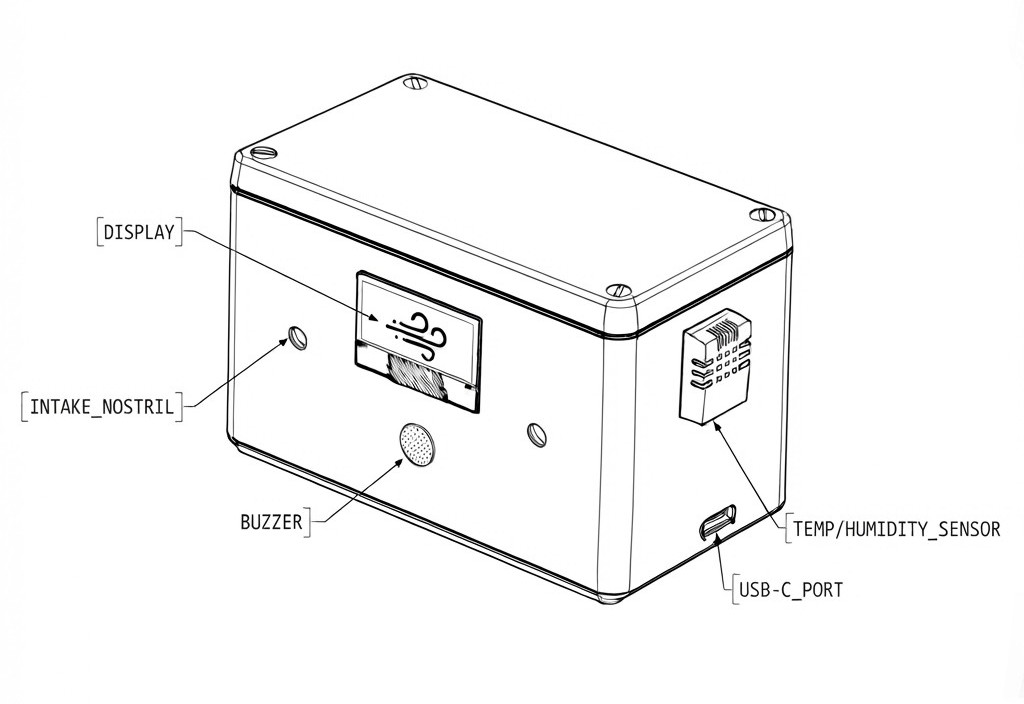
Replaceable sensors, active airflow, local alerting, and connections you can program.
Replaceable sensor array
Up to 6 MOX channels on a standard 4-pin connector. Sensors wear out — swap them in seconds, no shipping the unit back.
Active intake & exhaust
Micro-fan pulls a constant, clean air sample across the sensors. PTFE pre-filter keeps particulates off the elements.
Local alerting
OLED status display and a programmable buzzer. Faults surface with no phone, PC, or internet.
Connections you can program
USB Serial, Wi-Fi, and Bluetooth LE. The protocol is open, so your software can talk to it directly.
Build with it
Stream data, train detectors, and read everything programmatically.
- Connect and stream — USB Serial, Wi-Fi AP, or Bluetooth LE
- Sensor health tracking — a degrading sensor is flagged before it misleads you
- Record sessions and label events
- Extract 187-dimensional features for custom ML pipelines
- Read everything programmatically through an open SDK and protocol
- Contribute sensor drivers, profiles, and code
from opensmell import monitor

device = monitor.connect("BLE")
device.stream(callback=on_anomaly)
FAQ
How often do sensors need replacing?
Consumables, typically 3-6 months depending on the environment. Swap in seconds — no shipping the unit back.
Does it require an internet connection?
No. It works standalone with local alerts; Bluetooth streaming to Osmograph is optional.
Can I use my own custom sensors?
Yes. The 4-pin interface is open. You can build custom sensor arrays and write your own software profiles.
Why do I need a baseline before it works?
It learns normal from about 5 seconds of clean air and keeps the baseline updated. Every process defines its own normal.
Join the Waitlist
Smell Monitor is in active development. Join the waitlist and we'll reach out when pilot units are ready.