
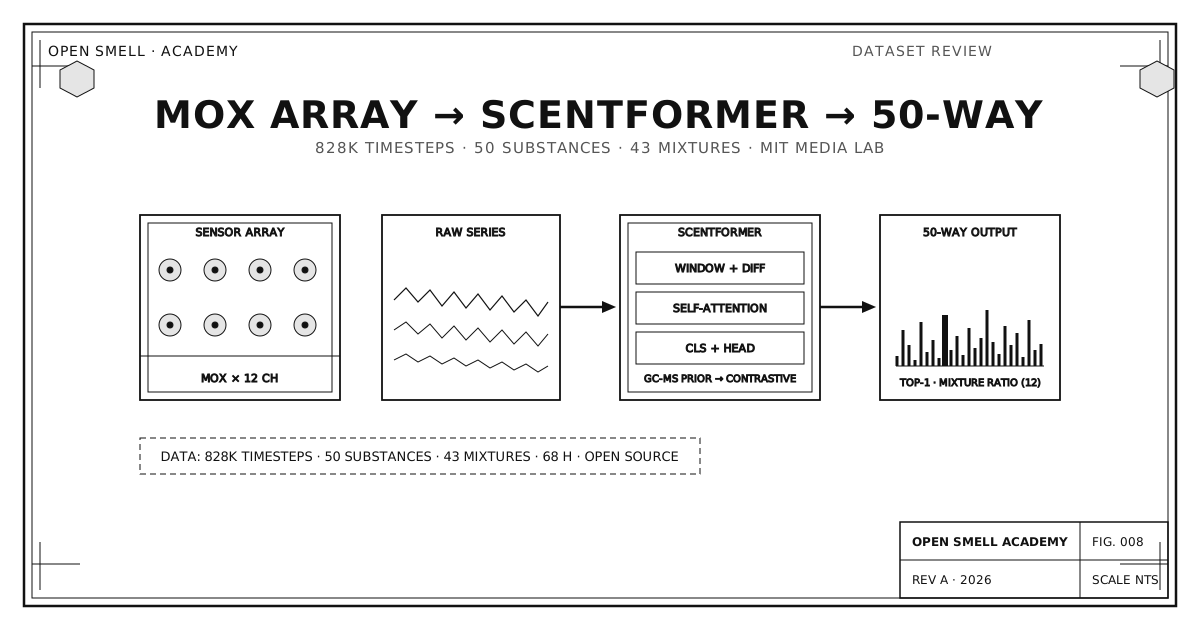
Every field needs a benchmark to move. Computer vision had ImageNet; language got GLUE and then a thousand leaderboards. Machine olfaction has never quite had one—mostly because the data was proprietary, tiny, or collected in chemistry labs on instruments nobody can afford. In 2025, MIT Media Lab released SmellNet: 828,000 sensor timesteps, 50 food substances, 43 mixtures, and 68 hours of recordings, gathered with cheap, portable metal-oxide (MOX) gas sensors and released openly. It is the first benchmark built for sensor-side smell recognition—and it is almost exactly the stack OpenSmell has been arguing for.
The Dataset: Real Food, Cheap Sensors
Previous smell datasets were either perceptual (human panel ratings, like Dravnieks) or lab-scale (bench instruments measuring pure chemicals). SmellNet is different: it points low-cost MOX sensor arrays at real objects—nuts, spices, herbs, fruits, vegetables—and records what the hardware actually reports.
- 828,000 timesteps across 50 base substances and 43 controlled mixtures, spanning multiple days and environmental conditions.
- 12 channels per recording: gas concentrations plus environmental factors (temperature, humidity, and the like).
- Two benchmarks: SmellNet-Base (recognise which of 50 substances) and SmellNet-Mixture (predict the ingredient ratios of a mixture over 12 base odorants, with seen and unseen splits).
Because it is a sensor dataset, it tests exactly the hard part of the open-stack vision: can models learn from the noisy, drifting, overlapping signals of commodity hardware, rather than from pristine lab measurements?
ScentFormer: Why Temporal Modeling
The accompanying model, ScentFormer, is a Transformer that treats each recording as a time series, not a point:
- Window and differentiate. The signal is split into sliding windows, and a first-order temporal difference is computed across each window. The paper reports this simple differencing step as worth roughly +16% accuracy on average across models—sharp changes in sensor readings carry most of the signal.
- Self-attention. A Transformer encoder learns which parts of the trace matter for the class.
- Read out. A classification head for the 50-way task; a ratio-prediction head for mixtures.
Temporal models consistently beat non-temporal baselines (MLPs, static features). The lesson is general: a smell is an event in time, and treating a reading as a single number throws away most of the information.
Chemistry as a Teacher: GC-MS Supervision
SmellNet's most distinctive trick is cross-modal supervision. At training time, each ingredient is paired with a GC-MS-derived chemistry embedding (from FooDB's volatile-compound database), and the model is trained with a contrastive objective to align sensor embeddings with chemistry embeddings. At inference time, only the cheap sensor is used—the chemistry stays behind as a teacher.
This mirrors the intuition behind OpenSmell's own representation stack: structure-based chemistry (the molecule-level chemoprint) and sensor-based measurements (the hardware-level trace) describe the same smell from two ends, and aligning them makes each half better.
What the Numbers Say
On SmellNet-Base, ScentFormer reaches 63.3% Top-1 accuracy with GC-MS supervision. On mixtures it reaches 50.2% Top-1@0.1 on seen mixtures and 16.0% on unseen mixtures — above random, and consistent with compositional learning. On novel environments the numbers are lower: real-world machine olfaction has not yet reached human-level performance.
SmellNet's own authors frame generalization to unseen mixtures and environmental drift as a core open challenge—temperature, airflow, sensor location, and aging all shift the readings. Publishing the full set of results, including the harder cases, is what makes a benchmark useful.
Why This Matters for Open Smell
SmellNet is external validation of the open-stack thesis this Academy has been building:
- It proves that commodity MOX arrays, the same sensors OpenSmell targets, can feed serious machine-learning research—no proprietary silicon required.
- It provides the sensor-side benchmark the field lacked, complementing perceptual datasets (Dravnieks, Pyrfume) and the UCI gas-sensor drift benchmark.
- It is open: code, data, and models released on GitHub, so anyone can build on it. That is exactly the "raise the tide" move the field needs.
The remaining gaps—mixture generalization, environmental robustness, and the gap between sensor readings and human perception—are the same problems OpenSmell works on. Benchmark culture is how a field compounds, and SmellNet is a step in that direction.
Sources & Further Reading
- A Large-scale Dataset for Real-world Smell Recognition. arXiv:2506.00239; ICLR 2026.
- SmellNet code, dataset, and ScentFormer: https://github.com/MIT-MI/SmellNet
- SmellNet dataset mirror: https://huggingface.co/datasets/DeweiFeng/SmellNet
- FooDB, food volatile-compound database: https://foodb.ca
- Persaud, K. & Dodd, G. Nature 299, 352–355 (1982) — the "broadly tuned array" idea SmellNet hardware inherits.