
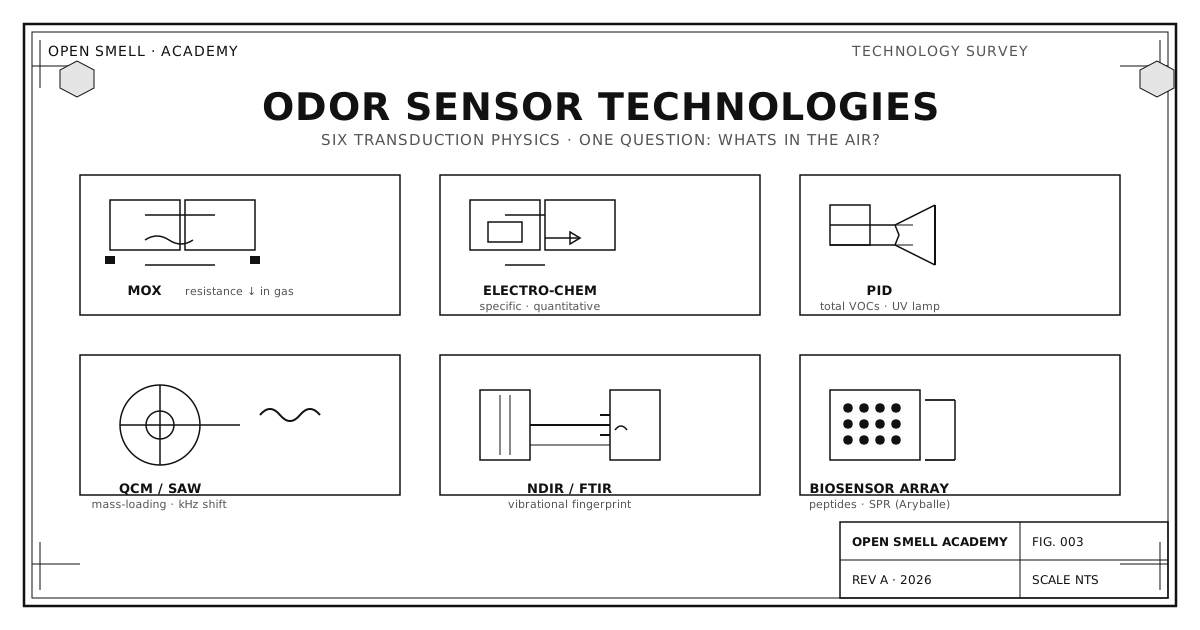
There is no universal smell sensor—and, given the physics, there may never be one. Odour is a mosaic: what reaches your nose is a mixture of dozens of volatile organic compounds (VOCs), each present at a different concentration, and different instruments "see" different slices of that mosaic. This guide surveys the main transduction technologies, what each one genuinely measures, where each fails, and how to choose.
The One-Table Comparison
| Technology | Transduction | Measures | Sensitivity | Selectivity | Cost | Speed |
|---|---|---|---|---|---|---|
| MOX (SnO₂) | chemoresistive | total reducing VOCs | ppm–ppb | very low | $ | s–min |
| Electrochemical | amperometric | specific gases (CO, NO₂, H₂S, O₂) | ppb–ppm | high | $–$$ | s |
| PID | UV photoionisation | total VOCs | ppb–ppm | low | $$ | ms–s |
| QCM / SAW | gravimetric | mass of adsorbed molecules | ppt–ppm | coating-dependent | $$ | s |
| NDIR / FTIR | optical absorption | functional-group bonds | ppm (%), not ppb | high (per bond) | $$$$ | s |
| GC-MS / GC-O | separation + mass | individual compounds | ppt–ppm | highest | $$$$$ | min–hr |
| Biosensor array (SPR) | optical, peptide-bound | affinity fingerprint | ppb–ppm | medium | $$$$ | s–min |
MOX — The Workhorse
Covered in depth in its own article. Cheap, rugged, cross-sensitive, humidity-prone. The default starting point for any e-nose because an array costs less than a nice dinner.
Electrochemical Cells — The Specific One
An amperometric electrochemical cell passes a gas over an electrode where it oxidises or reduces at a characteristic voltage; the resulting current is proportional to concentration. Because the electrolyte and electrode materials are chosen for a specific target (CO, NO₂, H₂S, O₂), these are the sensors in your household carbon-monoxide alarm—specific, quantitative, and power-miserly. Downsides: consumable liquid/electrolyte, limited lifetime, one gas per cell (so an "array" means one sensor per analyte, which scales badly).
Photoionisation Detectors — The Fast Total
A PID shines a 10.6 eV UV lamp at the gas; any molecule with an ionisation energy below that (most aromatics, many VOCs) loses an electron and the resulting current is measured. It is not specific—it reads "total VOCs"—but it responds in milliseconds and detects down to ppb. That makes it the instrument of choice for workplace safety sweepers and fugitive-emission surveys. You get a number, not a smell identity.
Quartz Crystal Microbalances — The Gravimetric
A QCM is a quartz disc oscillating at MHz frequencies. When molecules adsorb onto its coated surface, the added mass shifts the resonance frequency; the famous Sauerbrey equation makes the shift directly proportional to adsorbed mass:
Δf = -(2 f₀² / A√(ρ·μ)) · Δm
With a library of different surface coatings (polymers, cyclodextrins, metal-organic frameworks), you build a gravimetric array whose combined fingerprint identifies the sorbed mixture. SAW (surface acoustic wave) devices work on the same principle at higher frequency. Sensitive, reversible, but coating chemistry is where the real engineering lives.
NDIR & FTIR — The Spectroscopist
Infrared spectroscopy measures the bonds, not the smell: C–H, C=O, O–H groups absorb at characteristic wavelengths, so you can positively identify functional-group chemistry. Non-dispersive IR (NDIR) is the standard CO₂ sensor; FTIR is the laboratory workhorse. But ppb sensitivity is hard, instruments are expensive, and humidity—the air's dominant IR absorber—is a constant fight. This is the technology of the chemistry lab, not the pocket.
GC-MS / GC-O — The Gold Standard (and the Reference Point)
Gas chromatography–mass spectrometry separates a mixture into individual compounds, then identifies each by mass spectrum. It is the definitive answer to "what is in this air"—but it takes minutes, costs tens of thousands, and requires a trained operator. Its special sibling, GC-Olfactometry (GC-O), splits the column output between the mass spectrometer and a human sniffing port, so you learn which chromatographic peak is responsible for which perceived smell. GC-O is how you discover that a single compound at ppt concentration is what makes coffee smell like coffee.
Any serious odour project eventually leans on GC-MS as the arbiter of ground truth: the sensor array says "this smells like caramel," GC-MS says "it's 2-acetylpyrazine at 3 ppb."
Biomimetic Biosensor Arrays — The Aryballe Deep Dive
If MOX is the transistor, Aryballe is building the closest thing to an actual nose in silicon. Founded in 2014 in Grenoble, France, Aryballe pairs silicon photonics with peptide-based biosensors. At the heart of the technology is a silicon chip containing 64 Mach-Zehnder interferometers running in parallel, each coated with a different custom peptide that selectively binds VOCs. When a molecule binds, the local refractive index changes, the interference pattern shifts, and the change is transduced optically (surface plasmon resonance imaging in the earlier NeOse Pro generation; interferometry in the current Core Sensor).
Three details are worth stealing from their design:
- Peptides as the sensing surface. Peptides are small protein fragments with defined chemistry; a diverse peptide set binds a broad range of chemical families—more like olfactory receptors than like any single sensor material.
- The pattern, not the receptor. Like biology, Aryballe's value is in the ensemble: each odor produces a characteristic response across all 64 channels, rendered as an "olfactive signature" radar chart. A learning phase records signatures into a database; a recognition phase matches unknown samples against it. Two phases, exactly the train/infer split in ML.
- Fast regeneration. The binding is transient (physisorption, not chemisorption), so a clean-air purge desorbs the VOCs and the sensor is reusable within minutes. Peer-reviewed characterization with CEA-LETI measured reversible, ppm-level detection with events resolvable down to ~100 ms — fast enough for continuous monitoring, not just lab batches.
Aryballe sells the NeOse Pro and NeOse Advance benchtop analysers plus the Core Sensor Module (CSM) for OEM integration, and its customers span food, fragrance, cosmetics, and automotive. Academic work with CEA-LETI showed coupling a silicon micro pre-concentrator (Tenax TA, heated to 200 °C) improved the detection limit for n-nonane by ~125× and helped discrimination in humid samples. A companion peer-reviewed paper (Herrier et al., 2022) characterised the 64-MZI silicon nitride platform itself: a 22 × 4.7 mm die with a ~10⁻⁷ RIU bulk limit of detection, identifying VOCs at ppm level. This is the state of the art in commercially deployed biomimetic olfaction—and a strong argument that biology-inspired, optically-transduced arrays are the credible path to a general-purpose nose.
The Pattern-Recognition Layer Is the Real Instrument
Every technology above produces numbers; none produces "smell." The step from transducer readings to odour identity is a machine-learning problem, and it is the part OpenSmell is building in the open: standard feature extraction, the chemoprint representation, reference datasets, and trained classifiers that work across hardware.
So the practical advice when choosing sensors:
- Start with an MOX array (cheap, forgiving, information-rich).
- Add an electrochemical cell when a specific gas is your safety-critical target.
- Use PID when you need fast, absolute VOC totals.
- Rent GC-MS time when you need ground-truth speciation.
- Watch the biosensor/SPR space — it is where general-purpose digital olfaction is heading.
Sources & Further Reading
- Aryballe, Our technology and product datasheets (NeOse Pro, NeOse Advance, Core Sensor Module): https://aryballe.com
- EE Times, "Silicon photonics improves electronic nose" (2023).
- MDPI Chemosensors 8(3), 60 (2020) — SPRi + silicon µPC coupling for the NeOse Pro.
- Herrier, C., et al. "A silicon photonic olfactory sensor based on an array of 64 biofunctionalized Mach-Zehnder interferometers" (2022) — silicon nitride MZI platform, ppm-level detection.
- Sauerbrey, G. Zeitschrift für Physik 155, 206–222 (1959) — the QCM equation.
- Harper, W. J. "The strengths and weaknesses of the electronic nose." Advances in Experimental Medicine and Biology 481 (2001).