Osmo is the company that made digital olfaction mainstream news. It spun out of Google Research in January 2023 with a 70 million more, grown past 100 employees, and opened a 58,000-square-foot R&D and manufacturing facility in Elizabeth, New Jersey. This review looks at their science, their taxonomy of smell, and what their architecture means for everyone working on digital olfaction.
The Thesis: Sensor, Map, Printer
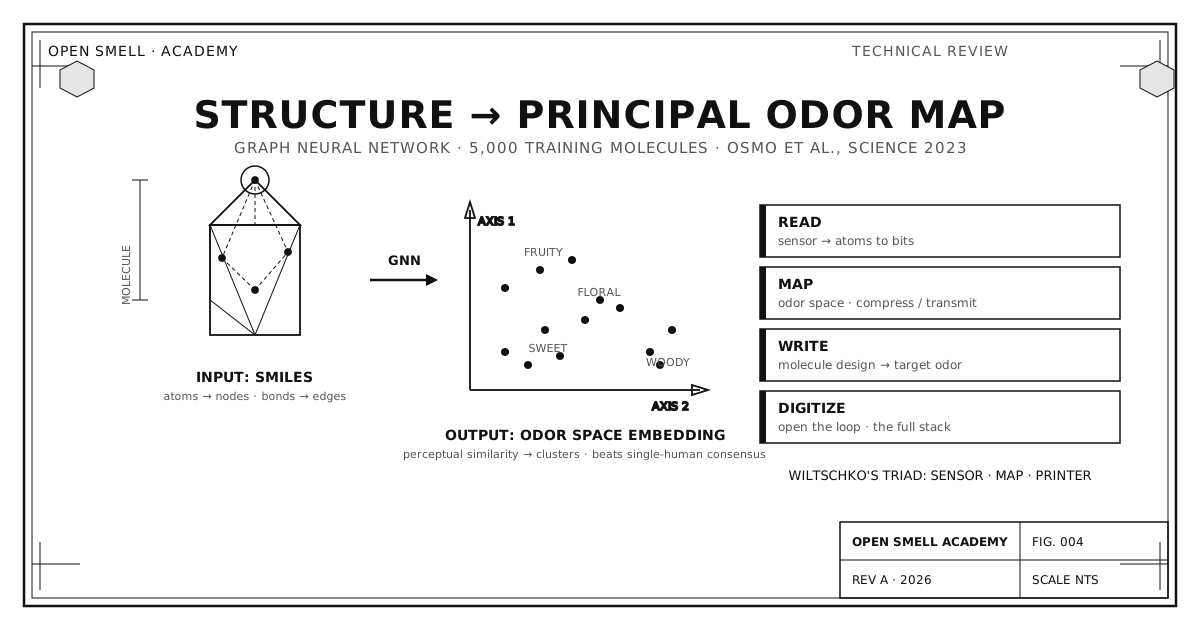
Wiltschko's framing is the cleanest description of digital olfaction ever put on a slide. To digitise smell you need three components:
- The sensor — converts atoms to bits (analogous to the camera's CMOS array).
- The map — organises, compresses, and transmits the bits (analogous to RGB colour space and JPEG).
- The printer — converts bits back to atoms (analogous to the speaker, or a chemical synthesizer).
His ambition is the "Shazam for smell," and his shorthand is that smell needs its RGB. It's the correct mental model, and OpenSmell shares it — we'll return to where we think the map should live.
The Science: The Principal Odor Map (POM)
The intellectual core is the Principal Odor Map, published in Science in September 2023 ("A principal odor map unifies diverse tasks in olfactory perception"), written with the Monell Chemical Senses Center, the University of Reading, and Arizona State University. It tackles the field's oldest problem — the Structure-Odor Relation (SOR): given a molecule's structure, predict what it smells like.
Here's what they actually did:
- Data. A message-passing graph neural network (GNN) trained on ~5,000 molecules with 138 odor descriptors, drawn from the public GoodScents and Leffingwell compilations.
- Task. Given a molecular structure, predict the human-perceived odor profile (floral, fruity, sweet, and so on).
- Result. On a prospective validation set of 400 odorants never used in training, the model's predicted odor profile matched the trained human panel mean (n = 15) more closely than the median panelist did — as the Science summary put it, substituting the model for an average human panelist would improve the overall panel description. A simple linear readout of the map generalised to other olfactory tasks (intensity, perceptual similarity, detection thresholds), and the map was used to plot ~500,000 potential odorants into odor space — most of them never synthesized, and roughly 70 person-years of continuous smelling for a human panel to characterise.
The POM is a structure-to-perception map: a learned, 256-dimensional embedding where molecules that smell alike land near each other, the way sRGB and the CIE color spaces locate colours. The paper's own framing is that the POM does for odor "what the CIE color space represents for vision." That is a genuine milestone — it validated at scale that smell is predictable from structure, a question that had been open for decades.
Follow-up work (Qian et al., eLife, 2023) showed the same embedding predicts olfactory receptor, neural, and behavioural responses across species separated by hundreds of millions of years of evolution — evidence that a shared, metabolically grounded odor representation runs through much of biology. That is the kind of result that changes how a field thinks.
Their Taxonomy of Smell
In 2025 Osmo published an actual, open scent taxonomy — the kind of resource the field has lacked since Aristotle's classes, and exactly the "common vocabulary" this Academy argues the field needs. It lives on GitHub as a data project:
- 11 Grand Families, 64 Subfamilies, and ~150 additional descriptors that combine to describe nearly any smell in existence — from perfumery to food to the environment.
- Built from public, cross-industry knowledge — flavor and fragrance literature, medical texts, food science, and academic olfaction research — sharpened by Osmo's perfumers and researchers into one consistent system. The letter introducing it is by Osmo's master perfumer, Christophe Laudamiel.
- Licensed as open data (ODC-ODbL) and published as machine-readable JSON, spreadsheet, and PDF (version 1.1, 2025), maintained in the open with community feedback via GitHub issues.
Why this matters beyond Osmo: the taxonomy is human vocabulary, not molecular structure — it names what things smell like (families, subfamilies, descriptors) rather than which atoms a molecule contains. That is precisely the perceptual-descriptor layer that supervises the POM (sweet, woody, floral are the map's labels), and it's the same layer OpenSmell's open stack wants to standardise. A common scent vocabulary is a data primitive: if recordings, models, and devices all reference the same descriptors, the entire field becomes more interoperable. Osmo's decision to release theirs openly is a gift to the community — and a good example of the openness this review argues compounds.
The company's near-term business is flavour and fragrance ingredients — designing potent, biodegradable aroma molecules — plus a 2023 Gates Foundation partnership applying the discovery engine to ingredient research. The long-term ambition, stated plainly, is the full triad: read, map, write — digitising scent the way the camera digitised vision.
Open Questions for the Whole Field
The POM is a genuine scientific achievement. The questions below aren't aimed at Osmo so much as the hard problems every serious attempt to digitise smell has to face — and they're worth naming precisely because Osmo has made them tractable enough to argue about productively.
1. A perception map encodes perception — which is a feature and a boundary. The POM is trained on human panels, and that makes it the right tool for fragrance, where consensus human perception is the product. It also means the map is perceptual rather than chemical: it encodes how people describe molecules, not which receptors they activate. This is the same boundary every colour space lives with — sRGB encodes the eye, not the photon — and it's worth stating clearly, because it defines what any structure-to-perception model can and cannot claim.
2. The sensor leg is the field's hardest open problem — for everyone. The POM predicts; reading the world still means turning atoms into bits with cheap, stable, interoperable hardware. That challenge is shared by every lab and company in digital olfaction, Osmo included, and it's the reason their near-term business is molecule design, where the map is the product. It's also the reason OpenSmell is sensor-first: we think the read side of the stack is where an open ecosystem can contribute the most.
3. Data is everyone's constraint — and why openness compounds. Foundations at this scale need large, labelled datasets, and the fragrance industry runs on trade secrecy. Notably, the POM itself rests on decades of public psychophysics — the Dravnieks Atlas, the GoodScents and Leffingwell compilations — and Osmo has been unusually willing to publish rather than hoard. OpenSmell's contribution is the same instinct pushed further: an open chemoprint, public datasets, and classifiers that run on commodity hardware, so the field's data problem gets solved once, in the open, for everyone.
Why It Matters
- The POM is the strongest published evidence that olfaction is learnable from structure — a milestone on par with early wins in image recognition.
- The sensor-map-printer triad has become the shared mental model of the entire field, which is no small thing for a field that has historically lacked a common vocabulary.
- Publishing the POM in Science, in collaboration with Monell, the University of Reading, and ASU, raised the scientific bar for the whole industry and gave the community a citable foundation to build on.
- The follow-up eLife work suggests the POM captures something real about biology itself, not just human panels.
The Bottom Line
Osmo has built the most significant map of odor space yet published, and the whole field is better for it. Their work moved structure-to-smell prediction from a research curiosity to a validated, scalable technique, and their sensor-map-printer framing is now the shared vocabulary of digital olfaction. The open questions above aren't Osmo's problems — they're the field's problems, and they're exactly why there's room for complementary efforts. OpenSmell's thesis is simple: build the open stack — the chemoprint, the data commons, the hardware — alongside the best maps anyone can make, and let the field compound. We'd rather help raise the tide than argue about which ship wins.
Sources & Further Reading
- Lee, B. K., et al. "A principal odor map unifies diverse tasks in olfactory perception." Science 381, 999–1006 (2023).
- Qian, W. W., et al. "Metabolic activity organizes olfactory representations." eLife (2023).
- Osmo, About and Building a map of odor: https://www.osmo.ai
- Osmo Labs, PBC. "The Osmo Scent Taxonomy," v1.1, 2025 (ODC-ODbL): https://github.com/osmoai/taxonomy
- Laudamiel, C. "The Osmo Scent Taxonomy" (letter): https://www.generationbyosmo.com/blog/osmo-scent-taxonomy
- Google Cloud blog, "How Osmo is digitizing smell with AI" (2023).
- Monell Chemical Senses Center, "A step closer to digitizing the sense of smell" (2023).
- Wired, "This startup is using AI to unearth new smells" (2023).