
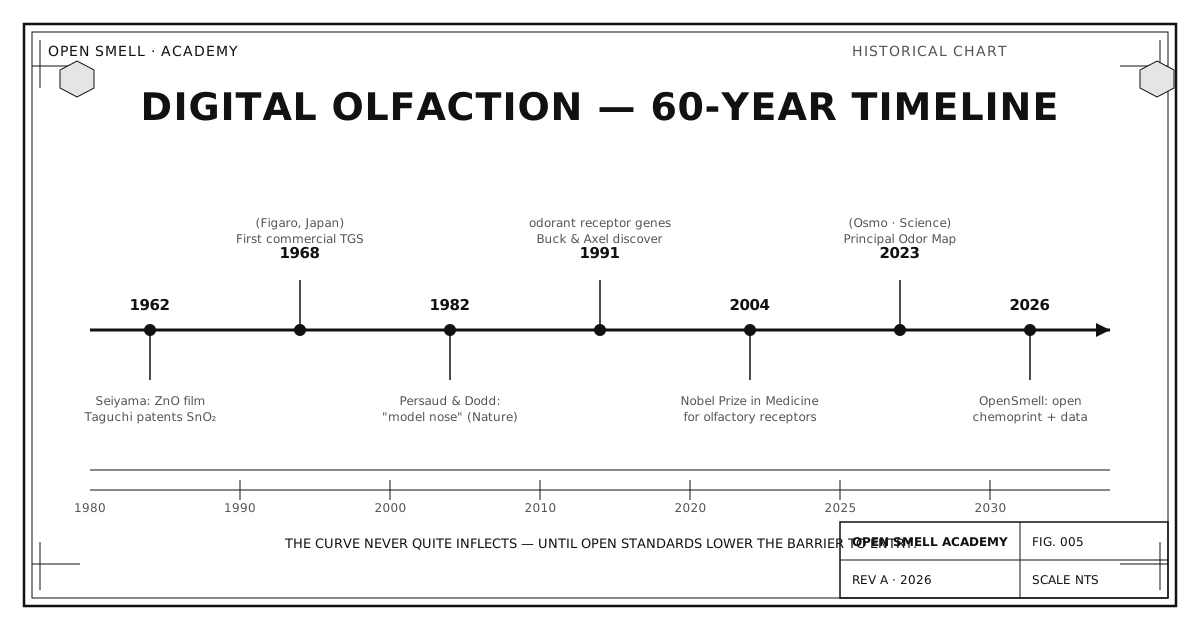
Every technology field has a decade when it "suddenly arrives." For digital olfaction, the pattern is always the same: decades of scattered invention, a missing standard, and then—when compute, sensors, and open data finally align—a decade of compounding. This is the long version of that story.
The Prehistory (300 BC – 1960)
Humans have been classifying smells longer than we've been measuring them. Theophrastus, Aristotle's student, wrote On Odours (~300 BC), the earliest surviving attempt to arrange smells into a system. Aristotle himself had proposed classes (sweet, pungent, sour, astringent); the taxonomy impulse is 2,300 years old. In 1756, Linnaeus proposed seven odor classes. In 1895, Hendrik Zwaardemaker built the olfactometer—a device to deliver controlled odour doses—and proposed his own classification. In 1961, Robert Moncrieff published The Chemical Senses, which, among other things, revived the theory that molecular vibrations (not just shape) explain odour. The question of shape vs. vibration would still be debated 60 years later.
The other prehistory is military. During World War II, the U.S. government tested ~19,000 compounds as insect repellents, a program that produced DEET and, decades later, would become a dataset that machine-learning researchers actually mined. Government-funded chemical sensing has funded this field from the start.
1962: The Sensor Is Invented (Twice)
1962 is the year that matters most. Two groups, independently:
- Seiyama and Kato reported the first thin-film zinc-oxide gas sensor—a device whose electrical resistance changed in the presence of gases.
- Naoyoshi Taguchi filed his patent on a tin-dioxide (SnO₂) gas sensor in Japan, motivated by the LP-gas explosion crisis in Japanese homes.
By 1968, Figaro Engineering had shipped the world's first commercial chemoresistive gas sensors (the TGS line), and by 1963 Taguchi had already discovered that palladium doping improves sensitivity. Within a decade, millions of Japanese households had a tin-oxide sensor quietly watching for gas leaks. The MOX sensor—the transistor of olfaction—was born before the microprocessor.
1982: The Electronic Nose Gets a Name
In 1982, Krishna Persaud and George Dodd (University of Warwick) published "Analysis of discrimination mechanisms in the mammalian olfactory system using a model nose" in Nature. Their insight was biological and profound: you do not need a specific receptor for every smell. You need a small array of broadly tuned sensors and a pattern-recognition layer. They built exactly that with semiconductor transducers and showed it could reproducibly discriminate odours. This paper (1,500+ citations and counting) is the founding document of the e-nose field, and every MOX array you can buy today—including OpenSmell's—is a descendant.
The 1980s also gave us the data: in 1985, Dravnieks published the Atlas of Odor Character Profiles—160 odorants rated by ~120 panelists on 146 descriptors. It is the first standardized, public dataset of human olfactory perception, and 40 years later it still anchors the field.
1991 & 2004: Biology Catches Up
In 1991, Linda Buck and Richard Axel published the paper that cracked olfaction's biology: the discovery of a vast multigene family encoding odorant receptors—roughly 1,000 genes in mice (about 3% of the genome), ~350–400 functional in humans. Each olfactory neuron expresses one receptor type; each receptor is broadly tuned to many molecules. Their discovery explained, at the molecular level, exactly why Persaud and Dodd's "broadly tuned array" architecture is the right one: evolution had already invented it. In 2004 they received the Nobel Prize in Physiology or Medicine.
The 1990s: Commercial E-Noses Boom and Bust
The commercial era arrived with names you rarely hear today: AromaScan, Cyrano Sciences' Cyranose 320, AlphaMOS (the FOX and PEN instruments), Neotronics and its olfaction line. These used polymer, SAW, and MOX arrays with PCA and neural networks. They were genuinely useful in labs—food quality, fragrance QC—but the market never scaled, because each device was a closed, proprietary island: incompatible file formats, incompatible sensor sets, no shared data. The dot-com era's e-nose bubble burst for the same reason the field keeps stalling: no open stack.
2000s–2010s: Commodity Sensors and the First Open Datasets
The hobby electronics boom (Arduino, then ESP32) made MOX sensors cheap enough to buy in quantity and wire in an afternoon. For the first time, thousands of people could build sensor arrays—and many did. The ML community got its workhorse dataset in 2012: the UCI Gas Sensor Array Drift dataset—13,910 measurements from 10 MOX sensors over 36 months—which remains the standard benchmark for sensor drift compensation.
On the data side, Pyrfume (led by the Monell Chemical Senses Center) began assembling a unified, open platform linking molecular identities to psychophysical data. GoodScents and Leffingwell's threshold databases compiled decades of industrial olfactory knowledge. The pieces of an open stack were quietly appearing.
2023: The Deep-Learning Landmark
In 2023, Osmo (a Google Research spinout) published the Principal Odor Map in Science: a graph neural network trained on 5,000 molecules that predicts human odor descriptors from molecular structure, generalises to never-before-smelled molecules, and beats single-panelist consensus prediction. It was the strongest demonstration yet that olfaction is learnable from structure. We review it in depth here.
2025–2026: Open Data Meets Commodity MOX
Where the deep-learning landmark worked from structure, the open-data era began working from sensors. In 2025, the MIT Media Lab's Machine Intelligence group released SmellNet — a benchmark built from portable, low-cost MOX gas sensors rather than lab instruments. It is exactly the "open primitive" this timeline keeps circling: 828K sensor timesteps, 50 base substances across nuts, spices, herbs, fruits, and vegetables, 43 controlled mixtures, and 68 hours of recordings, organised into a 50-way classification task (SmellNet-Base) and a mixture-ratio prediction task. It also introduced ScentFormer, a temporal model that learns from multichannel sensor time series with optional training-time GC-MS supervision — showing that the temporal dynamics of a metal-oxide array carry signal that a static feature vector leaves on the table.
SmellNet matters to this history for two reasons. First, it is the field's clearest sign that commodity MOX sensors are now good enough to anchor a serious open benchmark — the same sensor class at the bottom of this stack, at scale, in public. Second, its honest results are a reality check: its authors report that generalization to unseen mixtures remains a core challenge. The open datasets exist; the open standard is still being built. That is precisely the gap OpenSmell is trying to close.
2026: The Open-Stack Moment
Here is the thesis, stated plainly:
Every major leap in this 60-year history came from an open primitive—the tin-oxide sensor, the odorant-receptor gene family, the public dataset (Dravnieks, UCI, Pyrfume). Every stall came from a closed island—proprietary e-noses, incompatible formats, private data.
The technology to digitise smell has existed, in pieces, since 1962. What has been missing is exactly what cameras got in the 1990s: standard formats, shared libraries, interoperable hardware, and a data commons. That is what OpenSmell is building—the open stack that turns 60 years of scattered invention into a platform. The timeline's inflection point is not the next sensor. It is the next standard.
Sources & Further Reading
- Theophrastus, On Odours (~300 BC).
- Zwaardemaker, H. Die Physiologie des Geruchs (1895).
- Seiyama, T. & Kato, A. Analytical Chemistry 34, 1502–1503 (1962).
- Taguchi, N. U.S. Patent 3,631,436 (1967).
- Persaud, K. & Dodd, G. Nature 299, 352–355 (1982).
- Dravnieks, A. Atlas of Odor Character Profiles (1985).
- Buck, L. & Axel, R. Cell 65, 175–187 (1991).
- Nobel Prize in Physiology or Medicine 2004: https://www.nobelprize.org
- Vergara, A. et al. UCI gas sensor drift dataset (2012).
- Lee, B. K. et al. Science 381, 999–1006 (2023).
- Feng, D. et al. SmellNet: A Large-Scale Dataset for Real-World Smell Recognition, ICLR 2026. https://arxiv.org/abs/2506.00239