
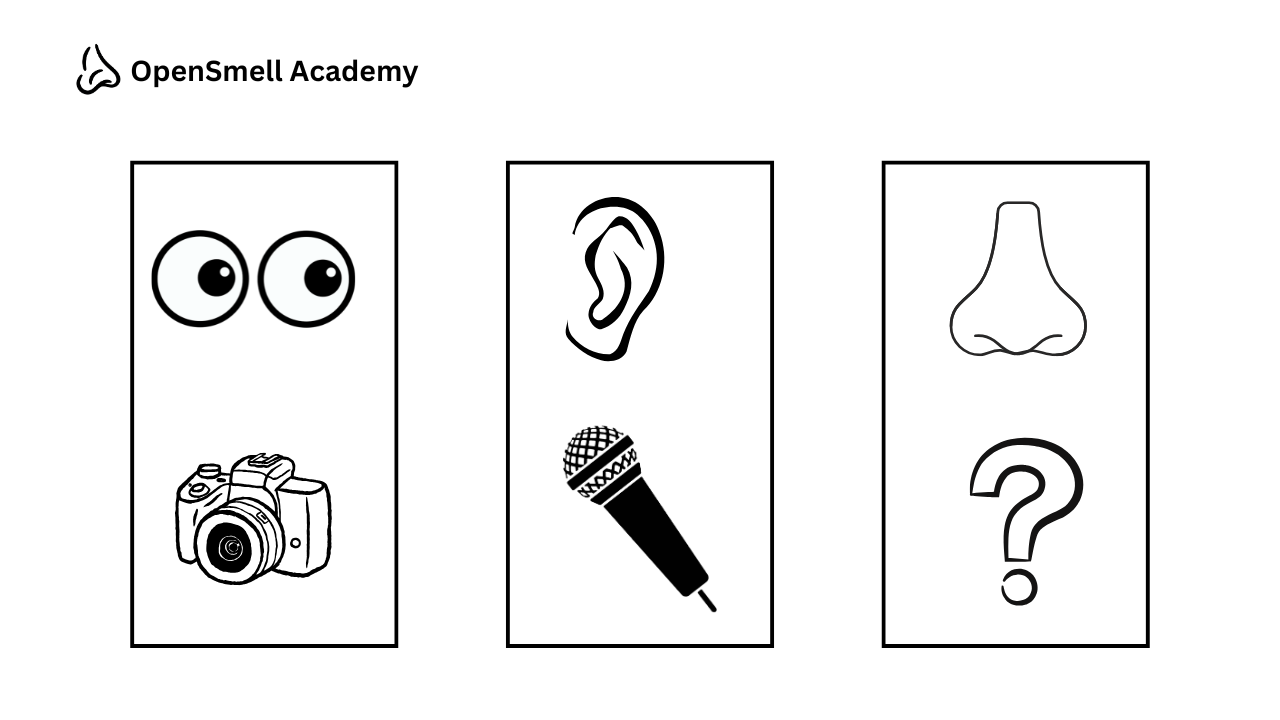
Technological advancement often follows a recursive pattern: the creation of knowledge enables new tools, which automate manual processes, thereby freeing human capital to solve more complex problems. This cycle is not merely a history of convenience but the engine of societal transformation. Major social shifts—from industrialisation altering labour dynamics to information technology reshaping communication—are often the downstream effects of prior technological emancipation, not their initial cause.
The mechanism is the externalisation of human capability. We model our innate faculties into reproducible, scalable systems:
- Fire externalised metabolic digestion.
- Writing externalised memory and narrative.
- The camera externalised vision, mastering the physics of light.
- The microphone externalised hearing, mastering the physics of sound waves.
We didn't just digitise our biology; we transcended it. Today we can see a single atom and hear the echo of the Big Bang.
But our chemical sense remains trapped in biology—subjective, unshareable, and unprogrammable.
Life without a Nose
We lack a standard .scent file format, a universal olfactory sensor, or a device capable of broadcasting a smell profile as seamlessly as a speaker emits sound.
Our primary instrument for chemical sensing remains biological: the human nose. Its output is a subjective, unshareable percept, or quale. Unlike the deterministic physics of light and sound, the mapping from a molecule's structure to its perceived odour is not defined by a simple, finite set of rules. This represents a profound explanatory gap in our scientific knowledge.
The absence of a digital smell platform has measurable costs. Food waste is a trillion-dollar global problem, yet a refrigerator cannot tell you that milk is spoiling until you open the carton and smell it yourself. Industrial facilities rely on workers carrying handheld detectors to locate toxic gas leaks. Doctors screen for certain cancers using expensive, invasive imaging that could one day be supplemented by breath analysis—if a standardised, interoperable olfactory platform existed.
The Camera and the Microphone Had a Stack. Smell Has None
Today, trillions of photos are taken every year, and cameras are embedded in every phone, doorbell, and car. The transformation was not driven by better optics alone. It required an entire engineering stack: standard file formats (JPEG, PNG), image-processing libraries (OpenCV), and platforms that let developers build applications without understanding the physics of CMOS transistors.
Sound followed an identical trajectory. MEMS microphones became tiny, cheap, and ubiquitous. Codecs like MP3 compressed audio efficiently. APIs like the Web Audio API made sound programmable in the browser. The result—podcasts, voice assistants, real-time translation—rests on an open, interoperable stack.
Smell has no such stack. There is no open-source library for odour classification. No standard format for a smell recording. No widely available, interoperable sensor hardware with a common data layer. The field is fragmented, and the cost is measured in wasted food, preventable disease, environmental damage, and missed scientific discovery.
Why Digitising Smell is Hard
Digitisation requires compression of a phenomenon's complexity into a predictive model. We achieved this for vision (wavelength + intensity) and hearing (frequency, amplitude, timbre). Olfaction presents a problem of exponentially higher dimensionality.
The human olfactory system employs roughly 400 distinct receptor types (about 350–400 are functional in humans). A single odourant molecule can activate multiple receptors, and a single receptor can be activated by numerous molecules. This creates a combinatorial explosion of possible signals, resulting in a perceptual space that is high-dimensional and poorly mapped. The field currently relies on descriptive taxonomies because it lacks a unifying, predictive theory that can reliably compute odour from molecular structure.
Some argue that smell is too subjective to measure. We once said the same about colour. Artists still debate dark red versus burgundy, yet we built colorimeters, RGB, sRGB, and cameras that reproduce colour accurately across devices. Sound, too, has its subjectivity—yet we have decibels, Fourier transforms, and audio codecs. Subjectivity does not prevent objective measurement. It simply means we need the right primitives.
Scientists still debate the exact mechanism of olfaction: one theory holds that molecular geometry determines receptor binding, while another points to quantum-mechanical vibrational frequencies. The truth likely involves both, and a complete causal explanation remains an open research question.
But a complete theory of olfaction is not a prerequisite for a useful digital nose. What is needed is a sensor that produces a stable, reproducible signal when exposed to a particular molecule, and a way to map that signal to something useful—a concentration, a classification, a spoilage alert. The physics for this already exists:
- Metal-oxide semiconductor (MOX) sensors — cheap, broad-spectrum, widely available.
- Infrared absorption spectroscopy — measures the unique vibrational fingerprint of molecular bonds.
- Electrochemical cells — specific to particular gases, quantitative.
- Quartz crystal microbalances — detect mass changes when molecules bind to a coated surface.
- Photoionisation detectors (PID) — measure total volatile organic compound concentration.
Each has tradeoffs in cost, specificity, and stability. None is perfect. But the bottleneck is not a lack of science. It is the absence of an open, interoperable engineering stack that makes any of these sensors easy to use, compare, and build upon.
The Imperative for Openness
History shows that foundational infrastructure—like the internet, Linux, or Python—thrives through open, collaborative development. Openness is not merely beneficial for olfaction; it is a methodological necessity. Only a transparent process of public code, data, and peer critique can accelerate the iterative failures and insights required to solve a problem of this complexity.
OpenSmell treats olfaction as a public engineering problem rather than a proprietary research puzzle. The aim is to build the same kind of infrastructure that turned cameras and microphones from niche instruments into universal platforms.
Conclusion
In 1975, when Steve Sasson showed his colleagues the first digital camera, they asked, "Why would anyone want to look at pictures on a television?"
That camera weighed eight pounds, recorded 0.01 megapixels onto a cassette tape, and was dismissed as a curiosity. Today, the camera is the most universal sensor on the planet.
The same transformation will happen to smell. It will begin with clunky devices, incomplete data, and failed experiments. It will seem impractical and niche—until suddenly it is not.
Get Involved
- Explore the code & data: https://github.com/opensmell
- Join the discussion: https://discord.gg/CGER3tHxbH
- Follow progress: https://opensmell.xyz
Sources & Further Reading
- Sasson, S. The first digital camera: a Kodak engineering story (1975).
- Buck, L. & Axel, R. "A novel multigene family may encode odorant receptors." Cell 65, 175–187 (1991).
- Nobel Prize in Physiology or Medicine 2004 — R. Axel and L. B. Buck.
- Persaud, K. & Dodd, G. "Analysis of discrimination mechanisms in the mammalian olfactory system using a model nose." Nature 299, 352–355 (1982).
- UNEP Food Waste Index Report — the roughly $1 trillion annual cost of food loss and waste.