
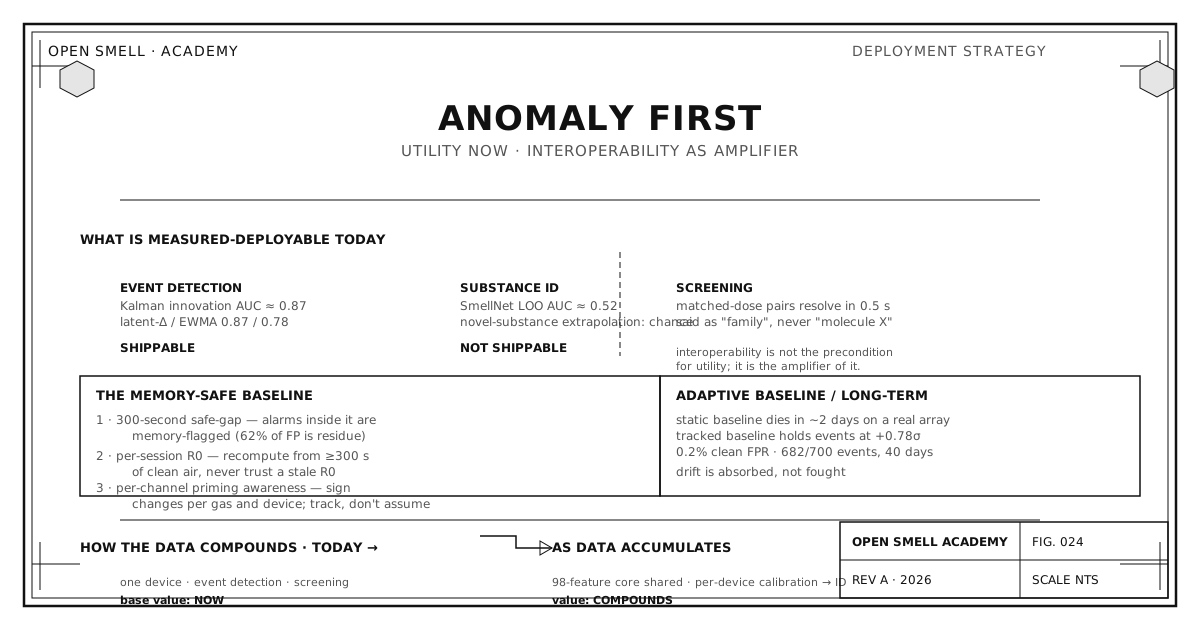
The single most common mistake in e-nose product planning is demanding interoperability before delivering any utility. The measured asymmetry is the fix: anomaly/event detection is deployable now on one device; substance identification is not. Ship the first, then let shared data grow the second.
What Is Measured-Deployable Right Now
Running the production residual axes on real corpora, the results are clean where they matter:
| Capability | Measured result | Verdict |
|---|---|---|
| Event detection (Kalman innovation) | AUC ≈ 0.87 | Shippable |
| Latent-Δ / EWMA-level | 0.87 / 0.78 | Shippable as fusion inputs |
| SmellNet leave-one-substance ID | LOO AUC ≈ 0.52 | Not shippable |
| Event/clean margin (archived Wörner alarms) | median +0.78σ, 0.2% clean FPR, 95% of files positive | Shippable with adaptive baseline |
| Long-term drift absorption (Wörner 40 days) | 682/700 detected, FPR flat 0.002–0.004 | Shippable with EWMA/DualKalman |
And the drift problem that kills static baselines is absorbed by the adaptive baseline: a static baseline dies within ~2 days on a real 62-channel array; the tracked baseline holds events at +0.78σ with 0.2% clean false-positive rate across 40 days.
The Memory-Safe Baseline the Deployable Device Needs
Wave-3 measured that event detection works with an adaptive baseline. Wave-4 added the missing piece: the baseline must also be memory-safe. Three rules, all from the audit:
- 300-second safe-gap. Any residual-axis alarm inside 300 s of a previous exposure is memory-flagged and down-weighted — 62% of clean-air false positives are memory residue, not real events.
- Per-session R0. Recompute the baseline each session from ≥300 s of clean air; never trust a stale R0 across gap boundaries.
- Per-channel priming awareness. The response depends on the previous chemistry, with sign that changes per gas and device — track it per channel, don't assume.
Why Identification Is Not Shipped
Honesty forces the asymmetry. Identifiability is bounded where it matters: matched-dose cross-gas pairs resolve in 0.5 s on clean windows (great for screening), but same-gas dose discrimination has a hard ceiling (the hardest pair is 0.779 — impossible at any window), and novel-substance extrapolation is at chance. So the deployed product says "something changed, here is how much, here is the family it best matches" — and never "this is molecule X with 95% confidence." Screening and event detection are the value; identification is the future calibration step.
The Strategy, in One Diagram
today              →      as data accumulates
─────────────────────────────────────────────────
one device                many devices
event detection           event detection everywhere
88.5% session-invariant   + the 98-feature core shared
screening                  + per-device calibration → ID
memory-safe baseline       + reference-point calibration
─────────────────────────────────────────────────
  base value: NOW               value: COMPOUNDS
Interoperability is not the precondition for utility; it is the amplifier of it. Every deployed device records into the same 98-feature core (the shareable feature whitelist), so the moment two devices share data, the per-device calibration path converts raw screening into comparable readings. Anomaly-first means you do not wait for perfect interoperability to start — and the data you naturally collect is the data the commons needs.
Sources & Further Reading
benchmarks/bench_anomaly_v2.json,bench_separability_margin.json,bench_sensor_memory.json— the measured anomalies, margins, and drift absorption.benchmarks/bench_detector_memory_fp.json— the false-positive decomposition behind the 300-second rule.benchmarks/bench_identifiability.json— the identifiability ceilings and screening windows.- The what-a-sensor-remembers essay — the technical detail behind memory-safe baselines.
- The what-session-invariance-means essay — why the 88.5% is representation-only, and why that is fine.