
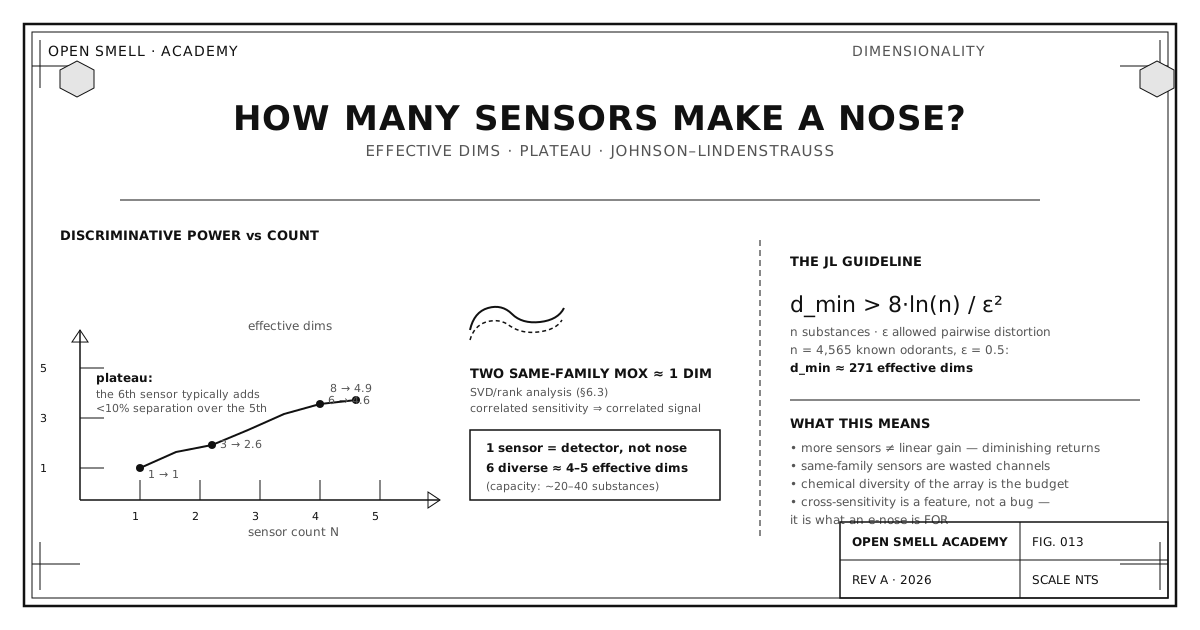
"How many sensors should my electronic nose have?" is the first question everyone asks and the hardest to answer with a single number. The answer is a curve: discriminative power grows steeply at first, flattens, and then nearly stops. The exact shape of that curve is governed by a few pieces of information theory, and knowing them saves you money and disappointment.
The shortest version: one sensor is a gas detector, not a nose. Six well-chosen sensors are a research instrument. Eight or more buy you almost nothing. Here is the reasoning.
Effective Dimensionality, Not Raw Count
A sensor array's power is not the number of channels; it is the number of independent degrees of freedom in the signals those channels produce. Two sensors that respond identically to every gas give you one dimension no matter how many units you wire up. The measured results are stark:
| Sensors | Effective dims | Max substances | Verdict |
|---|---|---|---|
| 1 | ~0.5–1 | 1 | Detector, not nose |
| 2 | ~1–1.5 | 2–4 | Marginal |
| 3 | ~1.5–2 | 3–7 | Proof-of-concept |
| 4 | ~2–3 | 8–12 | Conditional |
| 5 | ~3–4 | 12–20 | Yes, most applications |
| 6 | ~4–5 | 20–40 | Yes, research-grade |
| 8+ | ~5–6 | 30–60 | Diminishing returns |
The column that matters is effective dims — the rank of the response space after you normalize and remove the correlations the chemistry forces on you. Everything downstream, from how many substances you can separate to whether your model will transfer, is set by this number, not by the sticker on the array.
Why Two Same-Family Sensors Give You One Dimension
Metal-oxide sensors share the same sensing mechanism. Two MOX sensors of the same family (say two MQ-series units) respond to the same gases through the same surface chemistry, differing only in their (aᵢ, bᵢ) constants. Their responses to any substance are therefore strongly correlated: knowing one largely determines the other. Singular-value analysis of the recorded response space confirms it — two same-family MOX sensors behave like roughly one dimension, and even six identical MOX sensors collapse to a single dimension.
The takeaway is not "fewer sensors." It is that sensor selection matters more than count. A deliberately diverse array — a mix of MOX families, or MOX plus a different transduction technology such as an electrochemical cell or a photoionisation detector — buys real dimensions, while another near-identical MOX unit buys almost none. Compare:
| Array type | Raw count | Effective dims | ~Distinguishable substances |
|---|---|---|---|
| All MQ-series MOX | 6 | 3–4 | 12–20 |
| MQ + electrochemical + PID | 4 | 3–4 | 12–20 |
| All identical MOX | 6 | 1 | 1 |
| Micro-hotplate array (different T) | 4 | 3–5 | 8–30 |
Notice the middle rows: four diverse sensors match six same-family sensors. Diversity of transduction mechanism — or even of operating temperature, which shifts the surface chemistry — is worth more than extra channels of the same thing.
The Saturation Curve
The diminishing returns are not an artifact of a particular array; they are generic. The capacity table above shows the pattern: the second sensor adds roughly half a dimension, the fifth and sixth add fractions, and beyond eight sensors the curve is essentially flat. A frequently quoted empirical rule from the same measurements: the sixth sensor typically adds less than 10% separation over the fifth.
Why does the curve saturate? Real gases and real sensor physics give you a limited number of genuinely different response shapes. Humidity is common-mode across all SnO₂ channels, so it consumes a shared degree of freedom. Beyond a point, every additional channel you add is a noisy, partially redundant projection of the same few underlying factors. The array has hit its information ceiling.
The Johnson–Lindenstrauss Bound: The Ceiling in Numbers
There is a classical result that puts a number on this ceiling. The Johnson–Lindenstrauss lemma says that to embed n points in a Euclidean space while preserving all pairwise distances to within a distortion factor ε, you need at least about
dimensions. The connection to e-noses is direct: each substance is a point, the array's effective dimensions are the embedding dimension, and ε is the fraction of pairwise separation you are willing to lose. If you want an array to separate n substances with ε = 0.5 distortion, you need
| n (substances) | ε = 0.5 | ε = 0.3 | ε = 0.1 |
|---|---|---|---|
| 5 | 4 | 10 | 92 |
| 10 | 5 | 13 | 115 |
| 20 | 6 | 15 | 133 |
| 50 | 7 | 17 | 157 |
Two things stand out. First, for a handful of substances — the realistic target of a research or hobby array — a handful of dimensions genuinely suffices. Six effective dims cleanly separates 20 substances at ε = 0.5, which is the quantitative case for a six-sensor research array.
Second, the bound is a floor under ideal conditions. In practice, sensor noise and residual correlations double or triple the requirement, which is exactly why the measured "max substances" column of the capacity table (20–40 at six sensors) is so much smaller than the bound's ideal. And if your ambition is the entire odorant universe — the ~4,565 odorants in one common reference corpus — the bound says you need roughly 270 effective dimensions at ε = 0.5. No single-array e-nose is close to that, and none will be by adding cheap sensors. That ceiling is why the field's goal is reference libraries and per-rig calibration, not a universal nose.
Choosing an Array for a Job
The framework translates "which array" into a quantitative check. A model trained on a rig with certain capacity is only trustworthy on a rig with enough effective dimensions, so the stack carries a hardware-insufficiency gate: if the deployment rig's measured effective dimensions fall below the model's minimum requirement, prediction is refused or explicitly warned, never silently attempted with padded channels.
Practical guidance from the measurements:
- One sensor → a leak alarm ("is something there?"). Do not call it a nose.
- Three diverse sensors → proof-of-concept separation of a handful of beverages or chemicals.
- Four to five diverse sensors → most real applications: broad categories, food states, gas mixtures.
- Six diverse sensors → the research-grade sweet spot; the configuration the whole U-suite (§12) was validated on.
- Beyond eight → spend the money on calibration replicates instead; they buy more accuracy than another channel.
The Reason Cross-Sensitivity Is the Budget
There is a subtle inversion here worth stating plainly. A perfectly selective sensor — one that responds to exactly one molecule — would give you a detector for that molecule and nothing else. An e-nose with eight such sensors would be eight unrelated detectors: useful, but not a "nose," because it has no capacity for anything it was not specifically built for.
Cross-sensitivity is what makes an array a nose. Because each sensor responds to many gases, in different ratios, the array's vector space is densely populated with distinct, learnable signatures — and the JL bound says that space has real separating power. The art of array design is not maximizing selectivity per channel; it is maximizing diversity of sensitivity profiles while keeping the shared failure modes (humidity, temperature, poisoning) under protocol control. That is the same lesson the chemistry essay ended with, and it is the one every measurement in this series confirms.
Sources & Further Reading
- OpenSmell master reference, §6.2–6.5 (capacity table, selection, JL bound, failure modes) and §10.10 (the hardware-insufficiency gate).
- Johnson & Lindenstrauss, Contemporary Mathematics 26 (1984), 189–206.
- Wilson & Baietto, Sensors 9(7) (2009) — electronic nose survey.
- Marco & Gutierrez-Galvez, Sens. Actuators B 166–167 (2012) — signal processing for MOX arrays.